Monday, 18 April 2011

Viperfish (Chaliodus Sloani)

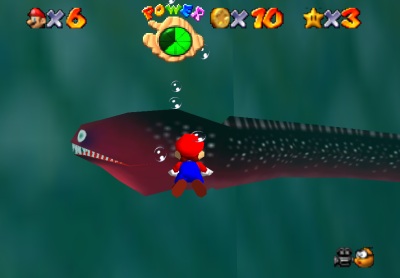
The first thing I thought when I saw a picture of this creature was “holy **** that is scary looking!” Then after seeing a few more pictures it reminded me of one of my favorite games as a child. If you have played Mario 64 and you have been to Jolly Roger Bay, well this thing reminds me of Unagi the Eel, just remove the lure on it’s head.
This scary looking deep-sea creature is one of the fiercest predators of the deep, it uses it long fang like teeth and lunges at its prey and spears it with those fangs. They are so long that it can not actually close its mouth - they in fact bends inwards a little bit and then go into its head, they actually sit behind their eyes. The first vertebra behind its head is designed to be a shock absorber so that when it lunges at its prey it does not break its neck. Another tactic this fish uses to catch its prey before it shish kabobs them is a lure. It has a long dorsal spine with a photosphore (light–producing organ) on the end to lure in its prey. So deep down in the dark ocean a fish will be minding its own business than it sees something shiny, when it goes to see what it is… BAM SHISH-KABOBED!

Despite its horrifying appearance it is a small fish, only 30cm (11 to 12 inches) in length on average. It is known to be silver, blue or green in colour, have huge fangs, an elongated dorsal spine and photosphores along its sides. The photosphores serve to camouflage itself from predators/rivals and to help find mates. Not much is known about the reproductive nature of this fish as it only comes to the shallower waters of 600m (2000ft) at night and sometimes there are young seen at night as well. During the day they dive down to 1500m (5000ft). Being a deep-sea predator food can be hard to come by so they have a slow metabolism and large stomachs so they can go days without food. They mostly feed on crustaceans and small fish so need to worry about these fish devouring you while deep-sea diving. They have predators of their own, mostly from what we see it is sharks and dolphins, I guess only more epic creatures can eat some epic like the Viperfish.

As stated before we do not know much about these fish as they are rarely seen by humans so we do not know how many there are, reproductive behavior, lifespan or natural behavior. We have got most of our information from accidental catches from trawlers and other styles of fishing. They usually do not live long in captivity and we have not studied them much in their natural environment.
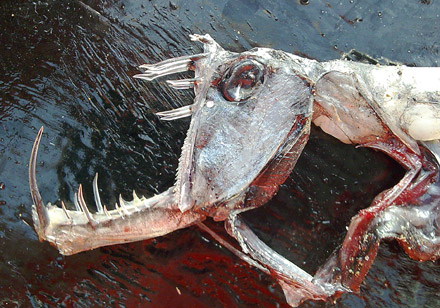
Lets recap: deep-sea diver, shish kabobs its prey, photosphore lure and a horrifying toothy grin! How could this creature not be EPIC?

Tuesday, 12 April 2011

Thylacine (The Tasmanian Tiger)


This Epic creature was the largest known carnivorous marsupial of modern times. The reason I used past tense is because it is now extinct, mostly because of the bounty that was put on them in their native lands (mostly in Tasmania but somewhat in Australia and New Guinea.) Also, competition from indigenous humans contributed to their extinction as well. They were seen as a threat to the farmer's sheep and chickens, there was a picture passed around in 1921 of a Thylacine with a chicken in its mouth, this help to secure the animals reputation as a poultry thief. This picture was later proved to be fake as it was a mounted Thylacine. For the most part, hunters are the reason the Thylacine is extinct!

The Thylacine has been around for about 23 million years (that is the oldest fossil evidence) and was officially labeled extinct in 1982 being that no proof of their existence was proved over the last 50 years prior. There have been 3800 reported sightings since it's extinction in 1932 but none have been proven. There are preserved specimens saved and research projects being held to try and clone them to bring them back, I wonder if John Hammond is funding them. Is that really a good idea to clone them, if that succeeds than what's going to stop them from making Jurassic Park and I don't think we'll have a Dr. Alan Grant to save us this time.

Two things about this creature that make them very unique is its pouch (which it gives birth to it's under developed young in) opens at its rear so it looks backwards to a Kangaroo pouch. It also can open its jaw at 120 degrees angle, making it look like something from a Stephen King novel or a John Carpenter.

The Thylacine is a nocturnal predator, which is the reason why there are disputes on whether the Dingo was competition for them as the Dingo was diurnal (meaning it is active during the day). The Thylacine resembles a large, short-haired dog with a stiff tail that smoothly extended from its body, very much like a Kangaroo, not surprising since they are both marsupials. They have brown fur on their backs and cream-brown fur on their belly, they also have 13 to 21 stripes on it’s lower back which is what gives it the nickname "Tiger". They were not very fast runners but have excellent stamina, they would chase their prey down until it got too tired, they were also ambush predators. They hunted kangaroos, wallabies, wombats, birds and small animals.


They were not very aggressive animals although people thought they were, probably because of the “threat” to farm animals. They were defensive though, they would growl and/or hiss followed by a threat yawn where they would show you how huge their mouth/jaw was and how wide it can open, basically saying "Don't mess with me, I’m scary looking!" They lived in large packs and bred year round as zoos reported joeys being spotted in the pouch at all times of the year.

There have been some cultural references to Thylacines, for example it is in the Tasmanian Coat of Arms, the cartoon Taz-Mania featured Wendell T. Wolf, which resembled a Thylacine and my favorite reference is in the book Leviathan by Scott Westerfeld. In Leviathan Dr. Barlow's character has a pet Thylacine named Tazza, many of the characters are surprised to learn that it is a natural creature and not one that is altered by Darwinist Scientists.

I deem the Thylacine Epic for its ability to open its jaw 120 degrees and look menacing! That is more than enough to be Epic for me!


Thursday, 7 April 2011

Gold Silk Orb-Weaver Spider


The female Golden Silk Orb-Weaver (genus Nephila) can be up to 18cm (7.2inch) toe to toe while the males are 2/3 that size. The females are so big that they are known to catch small birds and small lizards in their huge webs and eat them. If any spider will induce arachnophobia, this would be the one - they're huge! If you put that aside, they are quite a beautiful creature, sporting colours like yellow, white, orange, black and red in a variety of patterns unique to each spider. Most of the time they have black, orange and red striped legs, a white thorax and orange/red abdomen with white spots. They are solitary spiders only meeting to court, they are not very aggressive but the female will eat the male after courting if the male does not get away fast enough. Talk about a one-night stand.

The female will wrap her eggs in a silk pouch, then cover that in a brownish silk and most of the time hang it from her web so she can keep an eye on it. An egg sack can contain 300 to 1000 eggs. Spiderlings (babies) do not have fully developed venom glands, mouths, digestive tracts or the ability to spin their own silk. They will live with their mom for while until they cannot tolerate each other (other Spiderlings), at which point they will cannibalize each other. They usually leave not long before that point and start making their own lives.

They are not aggressive toward humans but they will bite if they feel threatened and cannot escape. If they feel threatened they will vibrate their web at a 40MHz frequency to try and warn the possible threat to back off. If that does not work then they will run, drop or jump away in the bush or foliage. If they do decide to defend themselves they have large fangs that can scar even hard tissues like the tissue on your fingers. Their venom* is potent but not lethal to humans, their venom is a neurotoxin like the Black Widow's but not nearly as strong. It will cause some swelling and blistering in the bite area that will only last for a few days unless you have an allergic reaction.

The most EPIC feature of this spider is the web they weave, they spin a huge orb shaped web that is yellowish-gold in colour when the sun is shining on it. Experimental evidence suggests it serves two purposes: the sunlit areas of the web attract bees that are attracted to bright yellow strands whereas the shady spots blend into the background foliage. The spider can control the intensity of the colour of the web so as to blend in or show more, they will produce more intensely coloured web if there is more sunlight in the area. When this spider weaves its web it makes a huge web one meter or so across. It first weaves a non-sticky spiral, then 2 to 20 more sticky spirals in between and when she is finished she will go in and fill in all the gaps. There are usually many support strands reaching many feet away. An adult spider may weave a web anywhere from eye level to high up in the tree canopy. A top horizontal support strand causing it to look incomplete and messy usually truncates the web. The spider has also been known to dismantle the bottom of the web on rainy and windy day to help prevent damage, that is very smart if I don’t say so myself. I do not know if I would think of that.

Some spiders have been known to abandon their web (although it is rare) and another spider may take over the web. When this is done the spider will change and make additions with her own unique style as each spider weaves their web differently. We may not be able to tell the difference at a glance but they are all as unique as every person’s handwriting. These spiders have been given the nickname "Writing Spider" because of the zigzag style the web appears in.

If an army of these spiders where to get together and built a web together they could easily entrap a human - thank god they do not eat us, they eat small birds, small lizards and other insects. Some people have thought that they eat some fruit because they often make webs around fruit but that is actually because it’s a prime location for catching fruit flies which are one of the insects they are most effective at catching. They make a good garden pet as they are effective pest controls and they will work for food, just don't piss it off.

Scientists tried to make their web synthetically and failed, they also tried coiling the thread from a spider (held down while pulling the silk out. Uck.) until it ran out to make clothes from them, thankfully that did not work out either. Some people do make clothes from their silk and there is one on display in the American Museum of Natural History, it took over one million females orb spiders to make it, does not sound like a good idea to me. From trying to do that they discovered a possible use in tissue engineering. A study from Medizinishe Hochschhule Hannover reports that processed Nephila silk is an excellent scaffold material thanks to its biocompatibility, mechanical strengths and it's property to promote cell adhesion and proliferation. Basically it acts as a guiding material for peripheral nerve regrowth. It may help people with nerve damage in the arms or leg, feet or hands and fingers or toes. That seems EPIC to me...

With its size, what it can eat, the amazing properties of its web and web weaving and possible uses of it's silk I deem this spider EPIC.

*Writing this blog I am going to end up talking about creatures with venom and poison so I would like to explain the difference as it is a common misunderstanding that they are the same when they are not. Venom is mostly used for hunting and self-defense, venom needs to be injected and if ingested then it will just make you sick but most likely not kill you. Poisons are substances that can cause damage, illness or death to organisms. Poisons cause a chemical reaction or other activity at the molecular level, this can be done by inhaling, injecting, contact or injecting, every poison is different. Both poison and venom are used for hunting or self-defense and never used in the animal kingdom just to kill. Killing for pleasure is only a human trait.

Wednesday, 30 March 2011

The Cassowary

This week’s EPIC creature is the second heaviest and third largest flightless bird, the Cassowary! You might ask: Why this bird over it’s cousins, the Emu and Ostrich? Well, that’s because neither of those birds could cause as much damage to you as the Cassowary! This 1.5m tall bird with its 125mm talons can disembowel you with one kick from its ferociously strong legs. As if this creature wasn’t dangerous enough, it goes for the throat - it would rather slit your throat than disembowel you but it’ll do that if it has to. WWII troops stationed in New Guinea were warned not to go around them as they will attack if they feel threatened, even the army was afraid of this EPIC bird! These birds live in a few different areas, such as New Guinea, Northeastern Australia, Aru Islands, New Britain, and Yapen.

To add to the EPIC nature of these birds, they are excellent jumpers, (jumping up to 1.5 metres!) very good swimmers, (they are known to swim in large rivers as well as the ocean) and they can run at 50Km/h. You can neither run nor hide from a Cassowary; it will get you if it wants to. To make it even scarier, the crest on its head (casques) is what it uses to make it’s trademark low growl which a very deep terrifying noise! It is like something prehistoric is coming after you, it’ll make you think you are in Jurassic Park all of a sudden.


 The best way to defend yourself from them is similar to a bear, get between something (like a tree) and the Cassowary and try to back away from it slowly with your arms in the air; though even then it might still chase you down.

All that said, they are actually shy solitary animals, they tend to know you are around long before you notice them and they will usually disappear into the rainforest. They are very excellent hiders; people believe it is because of its dark feathers and wedge shaped body. The males have a 7 km2 territory and the females have separate but overlapping territory that blend into the male’s, no surprised there.

One unique thing about these birds is that the only times one Cassowary meets another is to court, fight or if there is an abundance of food. When a male courts a female and is successful the female with make a heap style nest and leave the male to hatch the egg and rear the chick for 9 months. Once the female feels the male is doing fine with the egg, she will leave the male to find another and continue the cycle.
Cassowary eat a variety of things (flowers, fungi, snails, insects, frogs, birds, fish, rats, mice and carrion), most of them being fruit. The Cassowary is a keystone creature for the rainforest since it eats a lot of fruit and poops out seeds all over the place, which causes new trees and plants to grow - important for the rainforest to survive.

I bet you are wondering what they taste like; I bet you think it taste like chicken or turkey. One thing I do know from research is that their meat is very tough. It is said that if you were to cook Cassowary that you should put a stone in the water as well, once the stone is soft enough to eat then so is the Cassowary.

Many people fear this animal, and some want to kill them because they can kill us. Their attacks may be lethal, but they are not that common, we kill more of them with our cars then they kill us. Once, two teens, a 14 year old and a 16 year old decided to try and kill a Cassowary with a club. Instead, the Cassowary (being EPIC) kicked the 14 year old on the ground. The other teen tried to distract it but the Cassowary knocked him down and slit his throat (causing him to later die from blood loss) while the 14 year old ran away.  What did they expect when they tried to attack something as EPIC as the Cassowary, that it will just lay down and accept it? NO it is going use those crazy talons and kick some butt!

Friday, 25 March 2011

First Epic Creature - Water Deer

My first EPIC Creature is the Water Deer because of it's sabre-like canine teeth called tusk! The Water Deer  is not actually a true deer, it is a smaller version of the Musk Deer (which has the same tusks). The reason I choose the Water Deer over the Musk Deer is because it likes to hide in tall grass/swampy areas so you wouldn't see it if it decided to defend its territory from you. Not only does it have those tusks but it can move them, it can bend them inwards to make eating easier and then protrude them outward to make them more terrifying.


I mean look at those tusks! They can be up to 8cm's long!

It is mostly a solitary creature and is very stealthy so most likely you wouldn't know if it was around unless it is mating season. It's a very territorial animal so it would very likely try and remove you from it's territory. If it were mating season and you happened to be hiking in the territory of a full grown male while it's trying to impress the ladies, not only could it trample you like any other deer but it would stab you with those tusks.

They mostly live in the low reaches of the Yangtze River in the Jiangsu province and islands of Zhejiang in China so you are not likely to run into these. They are in some zoos in Britain and a few small deer farms in southern United States. That being said you are most likely not going to run into one.


Those tusks and those tusks alone are what make the Water Deer the EPIC Creature of the Week!