Saturday, 21 May 2011

The Elephant (Part 1)

This week’s creature is the largest living land animal on the planet and that description should be enough for most people to know what it is. They have one of the strongest olfactory senses in the wild and are one of the smartest animals. They are self-aware, can figure out puzzles and challenges more quickly than some people can and when they want to can be the friendliest creature or incredibly dangerous. They are feared, loved, respected, hated, considered sacred to some people and they like to get drunk sometimes. The elephant is an epicly wonderful creature and I will tell you why.
Being as well known as they are, there is not much need for description so I will just give you the basics. There are two main types of elephant, African and Asian. They are the largest land animal and can be up to 4 meters (13ft) tall, weighing up to 12000Kg (26000lb). They have very tough and wrinkly brown, grey or black skin, large thin fan-like ears, tusks, a small tail and the most famous feature of course is a long dexterous trunk (proboscis) which is also a nose, straw, snorkel and weapon. Elephants are herbivores; they eat leaves, grass, fruit, tree bark, and even sometimes tree branches. They have been known to knock over trees and let the tree sap or fruit ferment and then come back and eat/drink the booze created.

The trunk of an elephant is an amazing thing of nature (something that people try to recreate in the robot industry); it is the most important appendage for an elephant. The African elephant has two finger-like projections at the end of the trunk and the Asian elephant only has one. The trunk is delicate enough to pick up a single blade of grass and strong enough to push down a tree. They use their trunks to rip up their food and place it in their mouths, they will use their trunks to reach up high for food, shake and even knock the tree down to get at the food they want.

Elephants will suck up water (up to 14 litres (15 quarts)) and then blow it into their mouths to drink; they will also use their trunks to blow water, dirt and/or mud on them as a protective screen from the sun. Elephants even use their trunks as snorkels when swimming... yes, they can swim. Elephants have a highly developed sense of smell, they can stick their trunks in the air and swivel the tip from the side to side to locate friends, enemies and food sources. This is helpful if you’re trying to keep elephants out of the household because all you need to do is have fresh hot peppers about because the smell of them hurts the elephant’s nose.

The trunk is also used in social interactions; an elephant will entwine trunks as a handshake, will play wrestle with them, and caress other elephants in courtship or parent/child relationships. They will raise their trunks as a warning or threat, lower them to show submission, they can use them to fling off or grab enemies.

Elephants have two extruding upper incisors called tusks that continually grow; they can reach up to 3 meters (10ft) long and weigh up to 90kg (200lb). Both bull (or male) and cow (or female) African elephants grow large tusks but only the bull Asian elephant grows large tusks, while the cow grows very small ones or none at all. Much like how humans have a dominant hand, elephants have a dominant tusk that they use more which tends to be more rounded and worn down from use. Elephants use their tusks to dig for water and salt, to debark trees, to dig into trees for the pulp inside, move branches and trees to clear a path; they also use them as weapons and to mark territory. The tusks are mostly made of calcium phosphate (they are basically teeth), which we also call ivory, which is favored by sculptors for its softness when carving. That is why the elephant population is significantly smaller than it used to be. I think ivory is beautiful but I think keeping these epic creatures around is more beautiful!

One of the more unique parts of an elephant is the ear, they have huge fan like ears and African elephants have larger ones than the Asian elephants. They use these ears more for cooling themselves off than hearing. The elephant’s ears are filled with a rich network of blood vessels. When the elephants flap their ears it creates a cool breeze, this breeze cools off the blood and is then transferred throughout the body thus keeping the elephants cooled. Asian elephants live farther north in cooler climates so their ears are smaller as they need them less. Their ears are also used to show aggression - an elephant (most likely a bull during mating season) it will spread out its ears to intimidate the foe. If an elephant were to do this at you, get the heck out of dodge because the next thing that will happen is it will charge at you. One other thing male elephants use their ears for is during mating season the bull will produce a scent behind its ear, a musky smell and it will fan it around using its ears, this is used to attract a mate and can be smelled for miles around.

Elephants are very delicate with their feet when they want to be, there is an elephant that can pet a dog with it’s foot without crushing it; they are also very powerful tools when they want them to be as well. While an elephant walks their feet swell when they are on the ground, when they lift them up they shrink, this is helpful when more weight is applied to their backs and when walking through mud. Elephants cannot run because they have straight legs, they can walk fast which looks like a run but that is it. They can walk fast - up to 40km/h (25m/h). They have been known to charge and stampede when in herds, when they start doing that almost nothing can stop them, much like the juggernaut.


There was so much info on the elephant from my research that it was too large to do in one post so this one is a two parter, that is why it is so late as well. 


The following video is about two best friends, a dog and a elephant.


Wednesday, 11 May 2011

Hercules Beetle


This week’s creature is one of the biggest, baddest and most famous of its species…it has a wrestling move that no opponent can survive so don't enter a ring against this creature! The Hercules beetle has been in many card games, TV shows, made into toys, and probably even been in some movies. Growing up in the last few decades you’ve probably seen something on TV or read in some book or seen some toy that references the Hercules beetle but just haven’t noticed it or known what it was. After reading this hopefully you will, and teach the kids of the next generation what that crazy villain or superhero or toy is copying in the real world!

The Hercules Beetle is the largest of the rhinoceros’ beetle and third largest of all the beetles (following the Long-horned Beetle and the Titan Beetle) but this is only because of the horns on the male's forehead, the horns can sometimes be longer than their own body. Without that horn it would drop significantly in rank of size. The male Hercules Beetle can be up to 170mm (6.75inchs) long including the horn, it is very rare for them to get this big but it can. They can weigh up to 85g (3oz) and can lift with their horns up to 850 times it own weight which would be approximately 72.25kg (159lb)…Now that is strong and where it gets it's name from. If the average male could lift 850 times his weight (which is 86.6kg or 190.9lb, according to Wikipedia) he would be able to lift 73.610t (tonnes). You would be able to pick up a dozen cars in each hand and still be able to lift more. That strength makes it the strongest (comparative to its size) creature in the world, now that is Epic strong if you ask me!


Hercules beetles are very sexually dimorphic, meaning that males and females look very different. The females do not have two horns like the males do, but the actual body of the female is larger than the male. The males have two horns, the top longer one comes out of the thorax (its body) and the bottom comes out of the cephalon (the head). They are used to fight other male Hercules beetles for defense and for mating rights; what the beetle will do is pick up the enemy in its horns, fly up and slam it down into the ground causing the enemy to break its neck. Not only is it strong but it can give you one heck of a body slam! They can be various sizes and various colours but the distinctive features of them are the numerous small black spots on it hard shell that covers it wings and the small hairs on the bottom of the thorax horn.

The lifecycle of the Hercules beetle is not unusual for an insect but is longer than most. Once hatched from its egg, the larva spends up to two years tunneling/eating rotting wood; the larva looks like a large white caterpillar. Once they have stored enough energy they will turn into a hard shell and morph into the beetle, when the beetle is ready to come out they will moult (shed) their shell and emerge an adult. As adults they will roam the forest floor for decaying fruit, mate and fight; that's not a bad life if you ask me.

With its size, horns, strength, special body slam and longevity no wonder it is so famous. These same reasons are why I am deeming this creature Epic!

PS - I was originally going to write about the Titan beetle because of its size and the fact that the adult male does not eat for the adult part of its life but I could just not find enough information to make a decent size post. Instead I opted for a favorite creature of mine, the Hercules beetle.

Saturday, 7 May 2011

Amorphophallus Titanum

This week, we’ve got a super sized epic creature...The Amorphophallus Titanum has the largest unbranched inflorescence (or spadix) in the world; it can reach over three meters (or nearly 10 feet) long! The inflorescence happens to be the large stem in the middle of the flower... The Amorphophallus Titanum starts out as a large tuberous root called corm, which can weigh up to 200lbs. The corm grows and stores energy for up to ten years before it flowers. While developing, it can grow up to several inches a day, ultimately reaching up to nine feet and looking very similar to an ear of corn. When growth slows to one inch a day it is ready to bloom.
It blooms at night and becomes so hot from the process that it steams; a very unusual feature of this flower is that it heats itself. The spathe (flower petals) on the inside are deep purplish-red and the inflorescence is yellow. While blooming the smell this plant produces is akin to rotten egg, meat or fish, some people even say it smells like cheese. This smell is made to attract carcass-eating insects, as they crawl into the male flower the outer leaf closes on them. The male then discharges pollen on the insects then the leaves open up. Now when the insects investigate the female flowers they will fertilize them with the pollen stuck on them. To help prevent the bugs fertilizing other males, the females bloom after the males. After being fertilized the plant grows bright red fruit the size of olives then three days later the flower dies. However, the single leaf produced by the tuber grows into a tree-like plant that reaches up to 20ft tall and has a foliage spread of 15ft across, this allows the corm to begin storing energy again to be deployed years later.
The Amorphophallus Titanum is rarely seen flowering, but when it does it is announced by keepers and a showing is planned. There was a showing of a Amorphophallus Titanum on April 23rd 2011 at the Botanical Garden University of Basel and people held their noses closed as they watched this beautiful flower bloom! Another reason it is so rare is because it only grows in the Sumatra rainforest (Indonesia) on limestone hills and only if there is an opening in the bush for sun.

After seeing some pictures of this plant you may think “Geez that plant looks very phallic…” you are not the only one! Its scientific name “Amorphophallus Titanum” means “huge deformed penis”. Sir David Attenborough was aware of this and felt is was awkward calling it a huge deformed penis in Latin on his TV show “The Private Life of Plants” so he invented the nickname “Titan Arum”. In Indonesia the common name for it is “Bunga Bangkai” which roughly translates to “Corpse Plant” and that is where it gets its second common nickname.

The size, smell and lifespan of this flower are the reasons I deem this flower EPIC!

**You may also say “Hey isn't this an Epic Creature Blog, why is there a plant?” I would answer by quoting Wikipedia… “A creature is an organism [emphasis added]. The term is derived from the widespread historical belief that all such things were created, as by a deity or deities. The word is generally used to refer to non-human animals but does include humans.” Now that I cleared that up, in the future I may review creatures alive now, creatures from the past or even mythological creatures! **

Sunday, 1 May 2011

The Honey Badger


This week’s late post is about the Honey Badger; this is one crazy, fearless creature. When a honey badger wants something, nothing will stop it - it fears nothing. Despite it’s name it does not closely resemble the badger species, it resembles the weasels more. It is classed as a species of “Least Concern” to study by the IUCD due to it extensive habitat (most of Africa and a good part of India) and general environmental adaptations. The Honey Badger has a long body that is distinctly thick set and broad across the back. The skin is very loose, this allows it to turn and twist very easily which is very helpful when in the clutches of the enemy. The skin is also very thick; it is 6mm (0.24inches) thick around it’s neck to protect from biting as most animals go for the neck when attacking. The head is flat (useful when digging) with a short muzzle; eyes are small and ears are little more than ridges. They have short but very powerfully built legs, all armed with sharp claws which are short on the hind legs but very long on the forelimbs. The tail is short with long hair, while the hair on the rest of the body is short. The legs, lower body and face are black when its upper body is mostly white with some black in it giving it a salt & pepper look.
Now that you know what the Honey Badger looks like you can try and stay out its way because it does not matter the size, if you are in its way it will take you out with crazy claws and teeth. Guinness World Records has named it the most fearless animal! They are fierce predators that are mostly carnivorous and like poultry a lot. Unlike the Tasmanian Tiger, they have actually been a huge problem for poultry farms. However, they aren’t too choosey - they will eat just about anything else at hand. They are also proficient diggers so animals cannot easily hide from them, as the honey badger will dig them out and have been known to dig up human bodies and eat them. Animals can not hide in the trees either as the honey badger can climb trees very well so there is nowhere you can go to hide from them if they have you in their sights. One of their favorite treats is honey (hence the name) and they will climb trees (like Winnie the Pooh!) and knock the beehive on the ground and then devour the honey and larvae - since they have thick skin the bees barely bother them.
When Honey Badgers attack they are tireless, attacking until they can fight no more, their tireless nature in combat can wear out even larger predators like small bears. They have been known for surplus killing when attacking prey like on poultry farms one badger has been reported for killing a total of 53 chickens. They are also very intelligent and been witnessed using tools. A Honey Badger rolled a log and stood on it to reach a kingfisher fledgling stuck on roots in the ceiling of an underground cave. Their fierceness is so well known in nature that it is theorized that Cheetah cubs evolved similar colouring in their fur to ward off predators.
When trapped or in the clutches of a predator (lets say a Human) the looseness of its skin allows it to be able to turn around and bite it’s attacker while still being grabbed. The thickness of its skin is so tough that it has been known to prevent darts, arrows, and small caliber bullets. To it make it even scarier it screams when it is attacked to scare the daylights out its attacker.
This is one Epic Creature that you would rather meet with your eyes rather than your hands … and maybe even use binoculars so you can keep your distance. I will leave you with a video about it's Guinness Record.

Monday, 18 April 2011

Viperfish (Chaliodus Sloani)

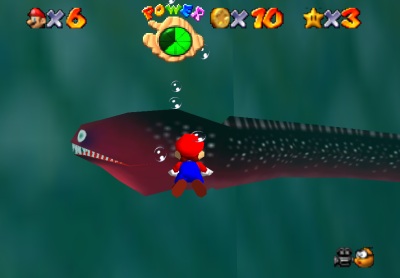
The first thing I thought when I saw a picture of this creature was “holy **** that is scary looking!” Then after seeing a few more pictures it reminded me of one of my favorite games as a child. If you have played Mario 64 and you have been to Jolly Roger Bay, well this thing reminds me of Unagi the Eel, just remove the lure on it’s head.
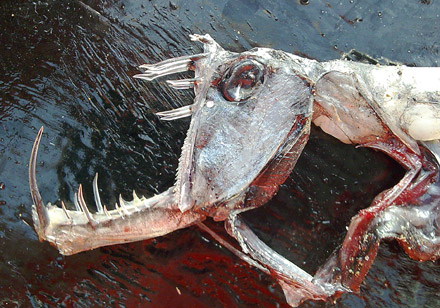
This scary looking deep-sea creature is one of the fiercest predators of the deep, it uses it long fang like teeth and lunges at its prey and spears it with those fangs. They are so long that it can not actually close its mouth - they in fact bends inwards a little bit and then go into its head, they actually sit behind their eyes. The first vertebra behind its head is designed to be a shock absorber so that when it lunges at its prey it does not break its neck. Another tactic this fish uses to catch its prey before it shish kabobs them is a lure. It has a long dorsal spine with a photosphore (light–producing organ) on the end to lure in its prey. So deep down in the dark ocean a fish will be minding its own business than it sees something shiny, when it goes to see what it is… BAM SHISH-KABOBED!

Despite its horrifying appearance it is a small fish, only 30cm (11 to 12 inches) in length on average. It is known to be silver, blue or green in colour, have huge fangs, an elongated dorsal spine and photosphores along its sides. The photosphores serve to camouflage itself from predators/rivals and to help find mates. Not much is known about the reproductive nature of this fish as it only comes to the shallower waters of 600m (2000ft) at night and sometimes there are young seen at night as well. During the day they dive down to 1500m (5000ft). Being a deep-sea predator food can be hard to come by so they have a slow metabolism and large stomachs so they can go days without food. They mostly feed on crustaceans and small fish so need to worry about these fish devouring you while deep-sea diving. They have predators of their own, mostly from what we see it is sharks and dolphins, I guess only more epic creatures can eat some epic like the Viperfish.

As stated before we do not know much about these fish as they are rarely seen by humans so we do not know how many there are, reproductive behavior, lifespan or natural behavior. We have got most of our information from accidental catches from trawlers and other styles of fishing. They usually do not live long in captivity and we have not studied them much in their natural environment.

Lets recap: deep-sea diver, shish kabobs its prey, photosphore lure and a horrifying toothy grin! How could this creature not be EPIC?

Tuesday, 12 April 2011

Thylacine (The Tasmanian Tiger)


This Epic creature was the largest known carnivorous marsupial of modern times. The reason I used past tense is because it is now extinct, mostly because of the bounty that was put on them in their native lands (mostly in Tasmania but somewhat in Australia and New Guinea.) Also, competition from indigenous humans contributed to their extinction as well. They were seen as a threat to the farmer's sheep and chickens, there was a picture passed around in 1921 of a Thylacine with a chicken in its mouth, this help to secure the animals reputation as a poultry thief. This picture was later proved to be fake as it was a mounted Thylacine. For the most part, hunters are the reason the Thylacine is extinct!

The Thylacine has been around for about 23 million years (that is the oldest fossil evidence) and was officially labeled extinct in 1982 being that no proof of their existence was proved over the last 50 years prior. There have been 3800 reported sightings since it's extinction in 1932 but none have been proven. There are preserved specimens saved and research projects being held to try and clone them to bring them back, I wonder if John Hammond is funding them. Is that really a good idea to clone them, if that succeeds than what's going to stop them from making Jurassic Park and I don't think we'll have a Dr. Alan Grant to save us this time.

Two things about this creature that make them very unique is its pouch (which it gives birth to it's under developed young in) opens at its rear so it looks backwards to a Kangaroo pouch. It also can open its jaw at 120 degrees angle, making it look like something from a Stephen King novel or a John Carpenter.

The Thylacine is a nocturnal predator, which is the reason why there are disputes on whether the Dingo was competition for them as the Dingo was diurnal (meaning it is active during the day). The Thylacine resembles a large, short-haired dog with a stiff tail that smoothly extended from its body, very much like a Kangaroo, not surprising since they are both marsupials. They have brown fur on their backs and cream-brown fur on their belly, they also have 13 to 21 stripes on it’s lower back which is what gives it the nickname "Tiger". They were not very fast runners but have excellent stamina, they would chase their prey down until it got too tired, they were also ambush predators. They hunted kangaroos, wallabies, wombats, birds and small animals.


They were not very aggressive animals although people thought they were, probably because of the “threat” to farm animals. They were defensive though, they would growl and/or hiss followed by a threat yawn where they would show you how huge their mouth/jaw was and how wide it can open, basically saying "Don't mess with me, I’m scary looking!" They lived in large packs and bred year round as zoos reported joeys being spotted in the pouch at all times of the year.

There have been some cultural references to Thylacines, for example it is in the Tasmanian Coat of Arms, the cartoon Taz-Mania featured Wendell T. Wolf, which resembled a Thylacine and my favorite reference is in the book Leviathan by Scott Westerfeld. In Leviathan Dr. Barlow's character has a pet Thylacine named Tazza, many of the characters are surprised to learn that it is a natural creature and not one that is altered by Darwinist Scientists.

I deem the Thylacine Epic for its ability to open its jaw 120 degrees and look menacing! That is more than enough to be Epic for me!


Thursday, 7 April 2011

Gold Silk Orb-Weaver Spider


The female Golden Silk Orb-Weaver (genus Nephila) can be up to 18cm (7.2inch) toe to toe while the males are 2/3 that size. The females are so big that they are known to catch small birds and small lizards in their huge webs and eat them. If any spider will induce arachnophobia, this would be the one - they're huge! If you put that aside, they are quite a beautiful creature, sporting colours like yellow, white, orange, black and red in a variety of patterns unique to each spider. Most of the time they have black, orange and red striped legs, a white thorax and orange/red abdomen with white spots. They are solitary spiders only meeting to court, they are not very aggressive but the female will eat the male after courting if the male does not get away fast enough. Talk about a one-night stand.

The female will wrap her eggs in a silk pouch, then cover that in a brownish silk and most of the time hang it from her web so she can keep an eye on it. An egg sack can contain 300 to 1000 eggs. Spiderlings (babies) do not have fully developed venom glands, mouths, digestive tracts or the ability to spin their own silk. They will live with their mom for while until they cannot tolerate each other (other Spiderlings), at which point they will cannibalize each other. They usually leave not long before that point and start making their own lives.

They are not aggressive toward humans but they will bite if they feel threatened and cannot escape. If they feel threatened they will vibrate their web at a 40MHz frequency to try and warn the possible threat to back off. If that does not work then they will run, drop or jump away in the bush or foliage. If they do decide to defend themselves they have large fangs that can scar even hard tissues like the tissue on your fingers. Their venom* is potent but not lethal to humans, their venom is a neurotoxin like the Black Widow's but not nearly as strong. It will cause some swelling and blistering in the bite area that will only last for a few days unless you have an allergic reaction.

The most EPIC feature of this spider is the web they weave, they spin a huge orb shaped web that is yellowish-gold in colour when the sun is shining on it. Experimental evidence suggests it serves two purposes: the sunlit areas of the web attract bees that are attracted to bright yellow strands whereas the shady spots blend into the background foliage. The spider can control the intensity of the colour of the web so as to blend in or show more, they will produce more intensely coloured web if there is more sunlight in the area. When this spider weaves its web it makes a huge web one meter or so across. It first weaves a non-sticky spiral, then 2 to 20 more sticky spirals in between and when she is finished she will go in and fill in all the gaps. There are usually many support strands reaching many feet away. An adult spider may weave a web anywhere from eye level to high up in the tree canopy. A top horizontal support strand causing it to look incomplete and messy usually truncates the web. The spider has also been known to dismantle the bottom of the web on rainy and windy day to help prevent damage, that is very smart if I don’t say so myself. I do not know if I would think of that.

Some spiders have been known to abandon their web (although it is rare) and another spider may take over the web. When this is done the spider will change and make additions with her own unique style as each spider weaves their web differently. We may not be able to tell the difference at a glance but they are all as unique as every person’s handwriting. These spiders have been given the nickname "Writing Spider" because of the zigzag style the web appears in.

If an army of these spiders where to get together and built a web together they could easily entrap a human - thank god they do not eat us, they eat small birds, small lizards and other insects. Some people have thought that they eat some fruit because they often make webs around fruit but that is actually because it’s a prime location for catching fruit flies which are one of the insects they are most effective at catching. They make a good garden pet as they are effective pest controls and they will work for food, just don't piss it off.

Scientists tried to make their web synthetically and failed, they also tried coiling the thread from a spider (held down while pulling the silk out. Uck.) until it ran out to make clothes from them, thankfully that did not work out either. Some people do make clothes from their silk and there is one on display in the American Museum of Natural History, it took over one million females orb spiders to make it, does not sound like a good idea to me. From trying to do that they discovered a possible use in tissue engineering. A study from Medizinishe Hochschhule Hannover reports that processed Nephila silk is an excellent scaffold material thanks to its biocompatibility, mechanical strengths and it's property to promote cell adhesion and proliferation. Basically it acts as a guiding material for peripheral nerve regrowth. It may help people with nerve damage in the arms or leg, feet or hands and fingers or toes. That seems EPIC to me...

With its size, what it can eat, the amazing properties of its web and web weaving and possible uses of it's silk I deem this spider EPIC.

*Writing this blog I am going to end up talking about creatures with venom and poison so I would like to explain the difference as it is a common misunderstanding that they are the same when they are not. Venom is mostly used for hunting and self-defense, venom needs to be injected and if ingested then it will just make you sick but most likely not kill you. Poisons are substances that can cause damage, illness or death to organisms. Poisons cause a chemical reaction or other activity at the molecular level, this can be done by inhaling, injecting, contact or injecting, every poison is different. Both poison and venom are used for hunting or self-defense and never used in the animal kingdom just to kill. Killing for pleasure is only a human trait.